
Heartburn is probably the symptom most people associate with GERD — but it is not the whole story. Gastroesophageal reflux disease (GERD) develops when acid reflux becomes frequent or persistent, allowing stomach contents to move back into the esophagus and sometimes reach the throat. The resulting irritation can be felt in the chest, throat and even the airways.
So, what are the 8 symptoms of GERD? The commonly recognized symptoms include heartburn, acid regurgitation, chest pain, difficulty swallowing, nausea, chronic cough, sore throat, and hoarseness or voice changes. Not everyone experiences all eight, and heartburn or regurgitation may be absent in some people with GERD.
Quick answer: The 8 common GERD symptoms are heartburn, regurgitation, chest pain, difficulty swallowing, nausea, chronic cough, sore throat, and hoarseness/voice changes.
What Are the 8 Common Symptoms of GERD?
| # | GERD Symptom | What It May Feel Like |
| 1 | Heartburn | Burning behind the breastbone or in the chest |
| 2 | Regurgitation | Acid, food or liquid coming back into the throat |
| 3 | Chest pain | Pressure, tightness or discomfort in the chest |
| 4 | Difficulty swallowing | Food feeling stuck or difficulty getting food down |
| 5 | Nausea | Feeling sick or uncomfortable in the stomach |
| 6 | Chronic cough | Persistent, often dry cough |
| 7 | Sore throat | Irritated or painful throat, sometimes with a lump sensation |
| 8 | Hoarseness | Raspy voice or noticeable voice changes |
These symptoms are described across major medical sources, including Cleveland Clinic and the National Institute of Diabetes and Digestive and Kidney Diseases (NIDDK).
1. Can GERD Cause Heartburn?
Yes. Heartburn is one of the most recognizable symptoms of GERD. It is usually experienced as a burning sensation in the middle of the chest, often behind the breastbone. The sensation may rise toward the throat when stomach acid moves upward into the esophagus.
It may become more noticeable after a large meal, when bending over, or while lying down. Nighttime heartburn is therefore commonly reported. If heartburn is happening repeatedly rather than occasionally, GERD may need to be considered.
Common clues include:
- Burning behind the breastbone
- Burning that moves toward the throat
- Symptoms after eating
- Symptoms becoming worse when lying down
- Nighttime heartburn
2. Can Acid Reflux Cause Regurgitation?
Yes. Regurgitation occurs when stomach contents are brought back up into the esophagus and sometimes into the throat or mouth. Acid, food or liquid may be noticed coming upward, and a sour or bitter taste can be experienced.
Unlike vomiting, regurgitation may happen without forceful retching. For some people, it may simply feel as though a meal or acidic liquid has suddenly come back up. When this happens repeatedly, especially alongside heartburn, GERD may be involved.
Regurgitation may be noticed as:
- Sour or bitter taste
- Acid coming into the throat
- Food coming back up
- Liquid returning to the mouth
- Backwash after meals
3. Can GERD Cause Chest Pain?
Yes, GERD can cause noncardiac chest pain. When the esophagus is irritated by reflux, discomfort may be felt behind the breastbone. Pressure, tightness or a heavy sensation may sometimes be experienced, which can make reflux-related chest pain difficult to distinguish from other causes.
However, new, severe or unexplained chest pain should not simply be blamed on GERD. Heart-related problems can produce similar symptoms and require urgent evaluation. This is one symptom where guessing at home is not a good idea.
| GERD-related chest discomfort | Why caution is needed |
| May feel like pressure or tightness | Heart problems can feel similar |
| Can occur with heartburn/regurgitation | Symptoms can overlap |
| May be associated with meals or lying down | A medical assessment may still be needed |
4. Can GERD Make It Difficult to Swallow?
Yes. Difficulty swallowing, known medically as dysphagia, can occur with GERD. It may be experienced as difficulty getting food down or as a sensation that food is stuck somewhere in the throat or chest.
When reflux repeatedly irritates the esophagus, inflammation or other complications can develop. In some cases, narrowing of the esophagus can also occur, making swallowing more difficult. Persistent or painful swallowing should be medically evaluated rather than being treated as ordinary acidity.
You may notice:
- Food feeling stuck in the throat
- Food feeling stuck in the chest
- Difficulty getting food down
- Pain while swallowing
- Repeated swallowing to move food down
5. Can GERD Cause Nausea?
Nausea can be experienced with GERD, although it is not specific to GERD. Reflux and regurgitation can create an unpleasant sensation in the stomach, and nausea may accompany that feeling. Appetite may also be reduced in some people.
This is where symptom combinations become more useful than one symptom alone. Nausea plus frequent heartburn, regurgitation or a sour taste can make reflux more plausible, while nausea by itself can have many other causes.
Nausea associated with reflux may occur with:
- Regurgitation
- Sour taste
- Heartburn
- Stomach discomfort
- Feeling unusually full
6. Can GERD Cause a Chronic Cough?
Yes. A persistent or chronic cough can sometimes be associated with GERD. When reflux reaches the throat or irritates the airways, coughing may be triggered. A dry cough can be particularly frustrating when no obvious respiratory infection is present.
The connection can become more noticeable at night because reflux symptoms may worsen while lying down. Wheezing or shortness of breath may also be experienced in some people when reflux affects the airways, although these symptoms should not automatically be attributed to GERD.
A reflux-related cough may be:
- Persistent
- Dry or irritating
- Worse at night
- Associated with throat clearing
- Present alongside heartburn or regurgitation
7. Can GERD Cause a Sore Throat?
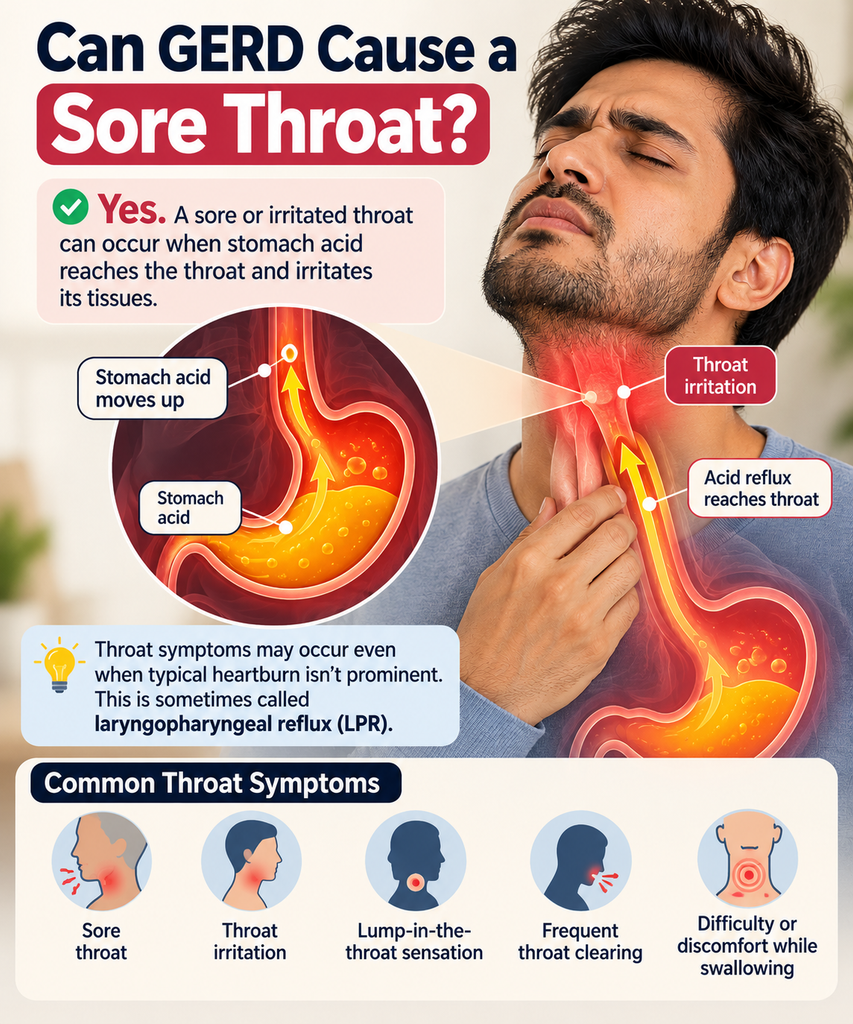
Yes. A sore or irritated throat can occur when reflux reaches the throat and irritates its tissues. A lump-like sensation may also be felt, and swallowing may seem uncomfortable.
Interestingly, throat symptoms may occur even when typical heartburn isn’t prominent. This is one reason reflux can sometimes be overlooked. Reflux that reaches the throat and voice box is often discussed as laryngopharyngeal reflux (LPR), which can be associated with throat irritation and voice symptoms.
Possible throat-related symptoms include:
- Sore throat
- Throat irritation
- Lump-in-the-throat sensation
- Frequent throat clearing
- Difficulty or discomfort while swallowing
8. Can GERD Cause Hoarseness or Voice Changes?
Yes. Hoarseness and voice changes can occur when reflux reaches and irritates the larynx, or voice box. A raspy or rough voice may be noticed, sometimes particularly after waking up.
This type of reflux may be associated with laryngopharyngeal reflux (LPR). Because hoarseness can also be caused by infections, allergies, voice overuse and other conditions, persistent voice changes should not automatically be labelled as GERD.
Voice-related clues may include:
- Raspy voice
- Hoarse voice
- Morning voice changes
- Frequent throat clearing
- Irritated voice box
Can GERD Cause Wheezing or Shortness of Breath?
It can be associated with wheezing and shortness of breath in some people. When stomach acid or refluxed material reaches the airways, irritation may be produced and asthma-like symptoms may occur.
These symptoms, however, should not automatically be assumed to be caused by GERD. Breathing difficulty has many possible causes and may require medical assessment, particularly when it is new, severe or worsening.
Are GERD Symptoms Worse at Night?
They can be. GERD symptoms may become worse while lying down because the position can make it easier for stomach contents to move upward. Large or fatty meals, particularly when followed by lying down soon afterward, may also aggravate symptoms.
That is why someone may notice nighttime heartburn, regurgitation, coughing, sore throat or hoarseness even when the daytime symptoms are relatively mild.
Nighttime GERD symptoms may include:
- Heartburn while lying down
- Acid coming back into the throat
- Nighttime cough
- Sore throat in the morning
- Hoarse voice after waking
Can You Have GERD Without Heartburn?
Yes. GERD does not always present with classic heartburn. Other symptoms such as regurgitation, chest pain, nausea, difficulty swallowing, chronic cough and hoarseness can occur.
This is particularly important when throat or respiratory symptoms are being experienced without obvious chest burning. The absence of heartburn alone does not rule out reflux, but these symptoms also cannot be used by themselves to diagnose GERD.
What Triggers GERD Symptoms?
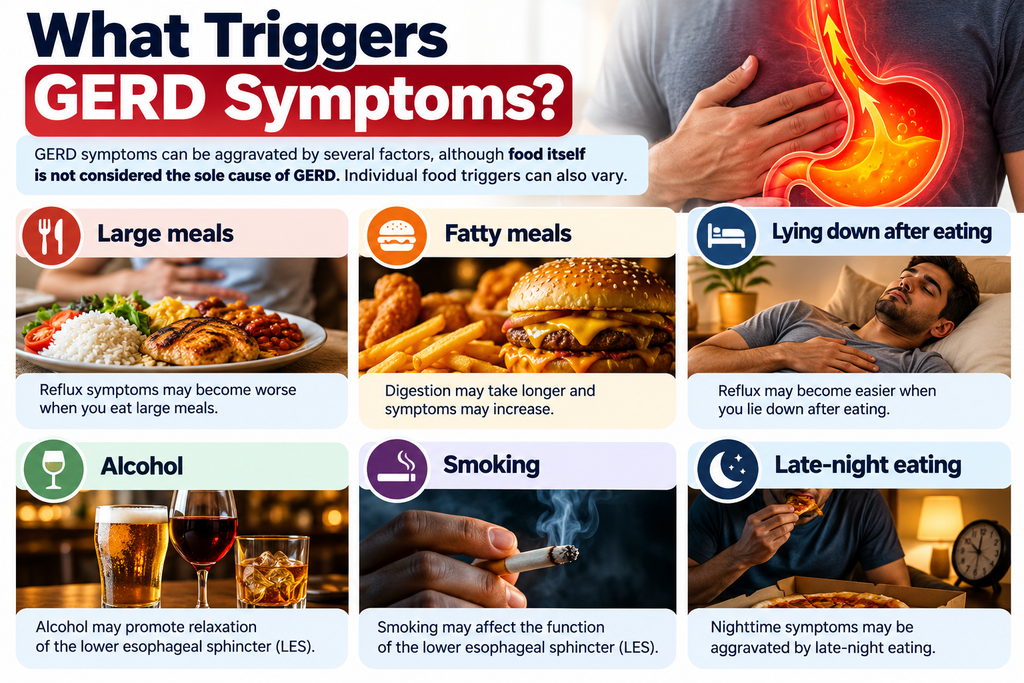
GERD symptoms can be aggravated by several factors, although food itself is not considered the sole cause of GERD. Large or fatty meals, lying down after eating, alcohol and smoking may make reflux symptoms worse. Individual food triggers can also vary.
| Trigger or situation | What may happen |
| Large meals | Reflux symptoms may become worse |
| Fatty meals | Digestion may take longer and symptoms may increase |
| Lying down after eating | Reflux may become easier |
| Alcohol | LES relaxation may be promoted |
| Smoking | LES function may be affected |
| Late-night eating | Nighttime symptoms may be aggravated |
When Should You See a Doctor for GERD Symptoms?
A doctor should be consulted when symptoms are frequent, persistent, worsening or interfering with daily life. Medical evaluation becomes particularly important when difficulty swallowing, painful swallowing, persistent vomiting, unexplained weight loss or signs of digestive-tract bleeding are present.
Chest pain deserves special attention. It should not be assumed to be GERD without appropriate evaluation, especially when it is new, severe or accompanied by concerning symptoms.
Seek medical attention for:
- Persistent or worsening GERD symptoms
- Difficulty or pain while swallowing
- Persistent vomiting
- Unexplained weight loss
- Vomiting blood
- Black or tarry stools
- New or unexplained chest pain
How Is GERD Diagnosed?
GERD is usually assessed first through symptoms and medical history. If the symptoms are unclear, persistent despite treatment, or suggest a complication, further testing may be recommended. A gastroenterologist may be involved in the evaluation.
Depending on the situation, tests such as upper GI endoscopy, esophageal pH monitoring, esophageal manometry or an esophagram may be used. These tests are not automatically required for everyone with reflux symptoms; the choice depends on the clinical situation.
How Is GERD Treated?
GERD treatment is generally based on symptom severity, frequency and whether complications are present. Lifestyle changes may be recommended, including eating smaller meals, avoiding lying down soon after eating, stopping smoking and identifying foods or drinks that worsen symptoms.
When medicines are needed, antacids, H2 blockers or proton pump inhibitors (PPIs) may be used depending on the situation. Persistent symptoms should be discussed with a healthcare professional rather than being managed indefinitely with self-medication.
Frequently Asked Questions About GERD Symptoms
What Is the Most Common Symptom of GERD?
Heartburn is one of the most common and recognizable symptoms of GERD. It is typically felt as a burning sensation behind the breastbone and may become worse after eating or while lying down.
Can GERD Cause a Cough Without Heartburn?
Yes. Chronic cough can occur with GERD even when classic heartburn is not prominent. Reflux-related irritation of the throat or airways may be involved.
Can GERD Cause a Feeling of Food Stuck in the Chest?
Yes. A sensation of food being stuck can be associated with difficulty swallowing, or dysphagia. Persistent or painful swallowing should be medically evaluated.
Can GERD Cause a Sore Throat and Hoarse Voice?
Yes. When reflux reaches the throat and larynx, irritation may be produced, with sore throat, throat clearing and hoarseness being possible symptoms.
Are GERD Symptoms Worse After Eating?
They can be. Symptoms may be aggravated after large or fatty meals and may become more noticeable if lying down soon after eating.
Can GERD Symptoms Occur Every Day?
They can, particularly when reflux has become persistent. Frequent symptoms should be discussed with a healthcare professional because recurring reflux can sometimes lead to complications affecting the esophagus.
Final Takeaway
GERD is more than just heartburn. Heartburn and regurgitation are classic symptoms, but chest pain, difficulty swallowing, nausea, chronic cough, sore throat and hoarseness may also be experienced.
If symptoms are becoming frequent, affecting sleep, making swallowing difficult or failing to improve with basic measures, a proper medical evaluation should be considered instead of assuming that every symptom is simply “gas” or acidity.
Medical sources used: Cleveland Clinic’s GERD overview, updated July 2026, and NIDDK’s GERD symptom, diagnosis and treatment information.